
- Course
Working with Collections in Oracle PL/SQL
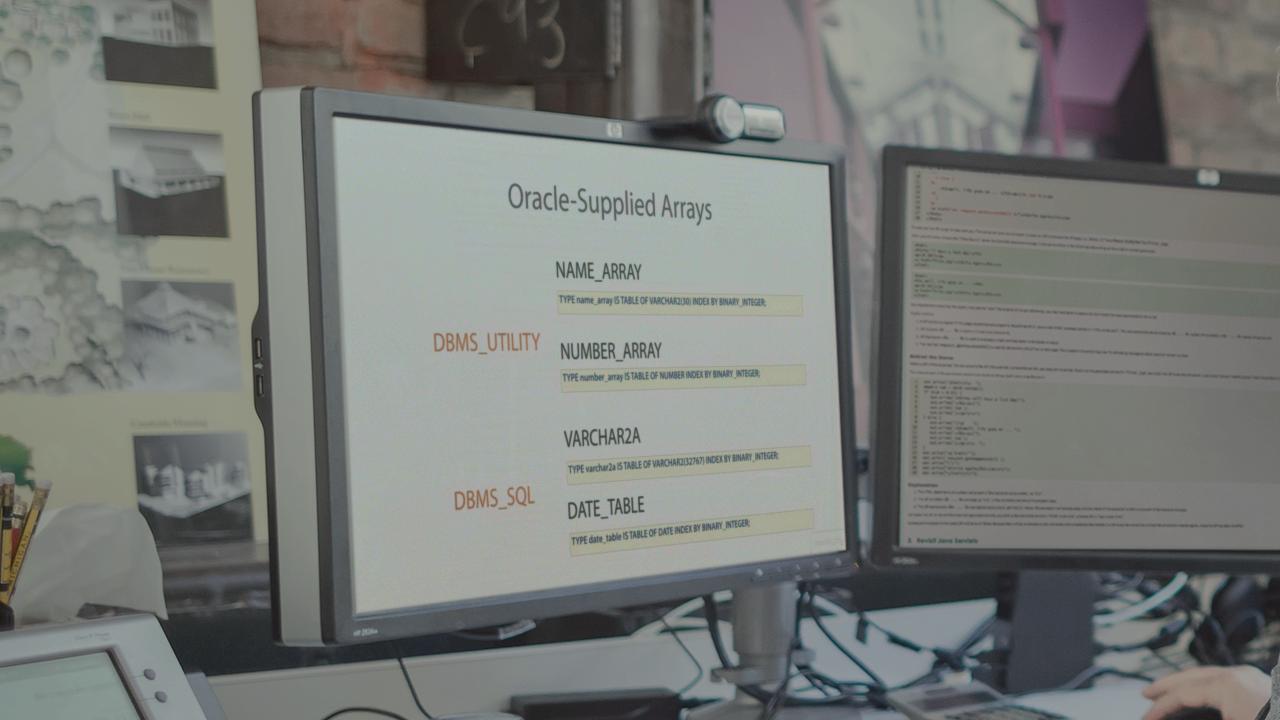
In this course, we will take an in-depth look at the collection types available in PL/SQL, namely Associative Arrays, Varrays, and Nested Tables. We'll also talk about the bulk fetch and collect features which greatly enhance the performance our PL/SQL code.
Intermediate
- Course
Working with Collections in Oracle PL/SQL
In this course, we will take an in-depth look at the collection types available in PL/SQL, namely Associative Arrays, Varrays, and Nested Tables. We'll also talk about the bulk fetch and collect features which greatly enhance the performance our PL/SQL code.
Intermediate
Get started today
Access this course and other top-rated tech content with one of our business plans.
Try this course for free
Access this course and other top-rated tech content with one of our individual plans.
This course is included in the libraries shown below:
- Data
What you'll learn
Oracle's relational databases are used by thousands of companies around the globe. PL/SQL (Procedural Language/Structured Query Language) is Oracle Corporation's procedural language extension for SQL which allows us to procedurally tie SQL statements to effectively define business logic. In this course, we will talk about collection types available in PL/SQL. Collections Types are an extremely important part of any programming language. The collection types, along with providing a mechanism to conveniently handle sets of data, can also boost performance. Oracle offers a rich set of collection types in Associative Arrays, Varrays, and Nested Tables. We will take an in-depth look at these powerful datatypes and get familiar with the Oracle bulk fetch and collect features which greatly enhance the performance of our PL/SQL code.
Working with Collections in Oracle PL/SQL
Intermediate
Table of contents
-
Module Overview | 50s
-
Defining Associative Arrays | 4m 1s
-
Assigning Values to Associative Arrays | 3m 35s
-
Demo: Assigning Values & Cursor Fetch to Associative Arrays | 4m 12s
-
Associative Array Index | 2m 20s
-
Demo: Associative Array Index | 1m 15s
-
Exceptions with Associative Arrays | 2m 26s
-
Demo: Exceptions | 1m 34s
-
FIRST & NEXT Collection Methods | 4m 29s
-
Demo: Associative Array Sorting | 2m 27s
-
Visibility & Session Persistence | 3m 18s
-
Demo: Session Persistence | 5m 58s
-
Oracle Supplied Associative Arrays | 1m 11s
-
Comparing Associative Arrays | 52s
-
Usage Guidelines | 43s
-
Summary | 1m 4s



Experienced technologist, with expertise in various aspects of software development lifecycle, architecting software solutions and software development.
