
- Course
Analyzing and Visualizing Resource Usage Using the Google Cloud Billing APIs
The big risk of cloud installations is that an enterprise will end up using expensive resources in an uninformed manner, and experience sticker shock when the billing cycle concludes. Learn to mitigate this risk in this course on the Billing API.
Intermediate
- Course
Analyzing and Visualizing Resource Usage Using the Google Cloud Billing APIs
The big risk of cloud installations is that an enterprise will end up using expensive resources in an uninformed manner, and experience sticker shock when the billing cycle concludes. Learn to mitigate this risk in this course on the Billing API.
Intermediate
Get started today
Access this course and other top-rated tech content with one of our business plans.
Try this course for free
Access this course and other top-rated tech content with one of our individual plans.
This course is included in the libraries shown below:
- Cloud
What you'll learn
The costs associated with working on the cloud are very different from those associated with traditional on-premise installations. Cloud-based installations have important attractions from a financial perspective - most importantly the pay-as-you-go billing model and the promise of increased capacity exactly when it is needed. However, it would be an expensive mistake to believe that cloud installations are always or inherently cheaper than on-premise installations.
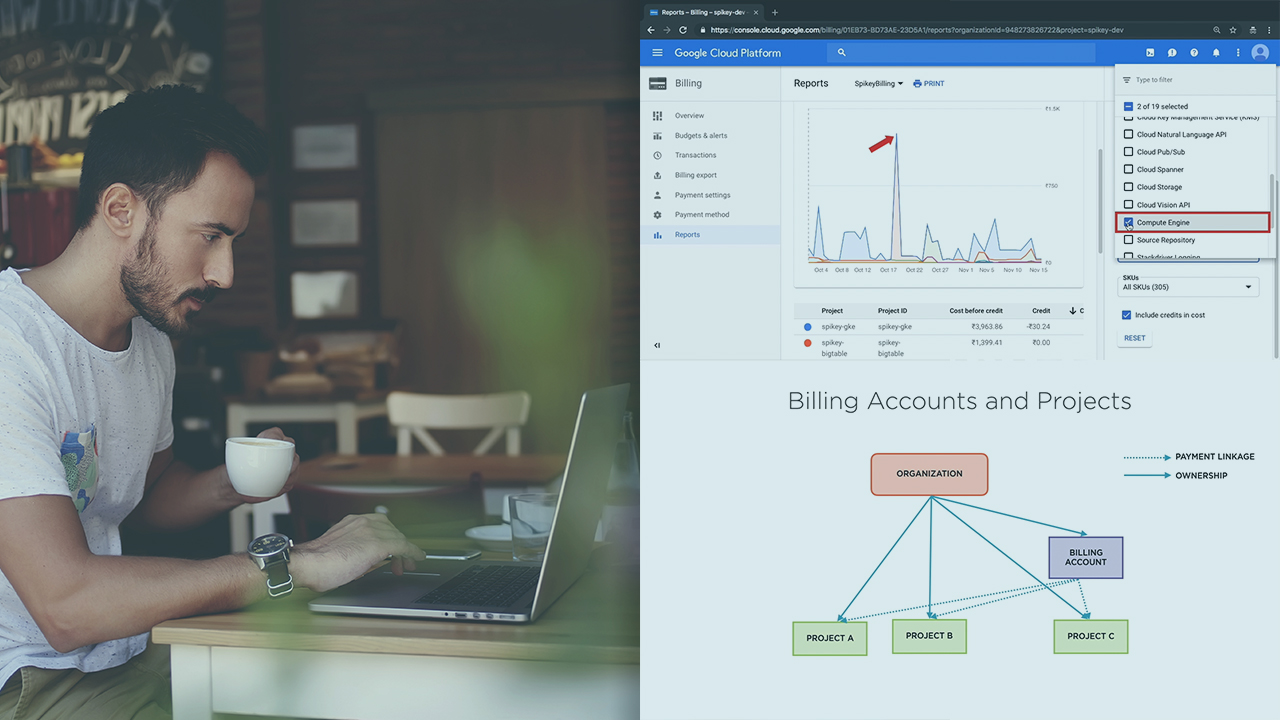
In this course, Analyzing and Visualizing Resource Usage Using the Google Cloud Billing APIs, you will see how you can use Google’s dashboards, analytics tools, and billing APIs to measure, analyze, and control your cloud bills.
First, you will be introduced to the various terms and concepts involved in billing such as organizations, projects, and resources. You will learn about the two different kinds of billing accounts: self-serve and invoiced, and understand the various billing roles in the Google IAM service that can be used to grant or limit a user’s access to billing information. You’ll also explore the billing console on the GCP using both the web interface and the gcloud command line utility.
Next, you will move on to resources that you can use on the GCP to measure, analyze, and visualize billing data. You will learn how to track your costs and payment history, transactions, and cost trends on the billing console. You’ll also see how you can export your billing details to Cloud Storage buckets or BigQuery, the GCP’s analytical warehouse, which can support your advanced billing related queries. Once your billing information is in BigQuery, you will see how you can use Data Studio to analyze spends and resource usage.
Finally, you will learn how you can set up budget alerts and receive notifications and manage billing details programmatically using billing APIs. You will also learn how you can configure access control to billing APIs and set up programmatic budget alerts using Cloud Functions and Pub/Sub.
When you are done with this course, you will have the hands-on experience working with billing on the GCP and know how to measure and analyze your cloud bills.
Analyzing and Visualizing Resource Usage Using the Google Cloud Billing APIs
Intermediate
Table of contents
-
Module Overview | 1m 2s
-
Prerequisites and Course Outline | 2m 2s
-
Resource Hierarchy on the GCP | 3m 47s
-
Billing Accounts in Detail | 2m 30s
-
Important Billing IAM Roles | 4m 19s
-
Exploring Billing on the Web Console | 4m 9s
-
Using the gcloud Command Line Utility to Query Billing Information | 2m 55s
-
Pricing | 45s


An engineer and tinkerer, Vitthal has worked at Google, Credit Suisse, and Flipkart and studied at Stanford and INSEAD. He has worn many hats, each of which has involved writing code and building models. He is passionately devoted to his hobby of laughing at his own jokes.
